![MNML Aesthetics text logo-2.png]](https://www.mnmlaesthetics.co/hs-fs/hubfs/MNML%20Aesthetics%20text%20logo-2.png?height=21&name=MNML%20Aesthetics%20text%20logo-2.png)
Why this study is in the MNML Tone evidence library
MNML Tone is the clinical name used by MNML Aesthetics for the eMVFit platform evaluated in the peer-reviewed pilot study summarized in this document. In the published manuscript, the device is referenced as eMVFit (Weero Co., Ltd., South Korea); in our evidence library and provider education, we refer to the same platform as MNML Tone. The study is included because it provides objective, ultrasound-based evidence that this multilayer approach (bipolar RF + EMS + vacuum suction with temperature control) can reduce subcutaneous abdominal fat thickness and increase rectus abdominis thickness after a structured treatment series.
In a knowledge base context, this article is meant to be both (1) scientifically rigorous and (2) easy to follow, so providers can translate the evidence into clear, accurate patient education.
Executive Summary
What was tested: An 8-week abdominal protocol combining bipolar RF (1 MHz), EMS, and vacuum suction delivered in 16 sessions (30 minutes each, twice weekly).
What was measured: Ultrasound thickness of abdominal subcutaneous fat and rectus abdominis muscle, plus waist circumference, body weight/BMI, patient satisfaction, and safety.
What was found (1 month post-series): Subcutaneous fat thickness decreased by 0.24 in (-26.27%), rectus abdominis thickness increased by 0.09 in (+18.83%), and waist circumference decreased by 0.84 in, with no adverse events reported.
Primary Source
Bae K-T, Jung H-W, Lee D-S, Wan J, Yi K-H. Ultrasonographic Measurement After Multilayer Stimulation for Body Fat Reduction and Muscle Strengthening: A Pilot Study. Plastic and Reconstructive Surgery - Global Open. 2025;13:e7175. Published online November 11, 2025. doi:10.1097/GOX.0000000000007175.
Study Design and Methods
Design
Prospective, single-center, nonrandomized pilot study. Each participant served as their own control via baseline vs posttreatment comparisons. The posttreatment endpoint was 1 month after the final session, which is relevant because remodeling effects from energy-based therapies can continue after a series ends.
Participants
N = 20 healthy Asian adults (15 women, 5 men), ages 28-50 years, with BMI 22-28 kg/m^2. Exclusion criteria included pregnancy/lactation, implanted electronic devices, active infection or dermatologic disease in the treatment area, metabolic/cardiovascular disease, and recent abdominal procedures.
Intervention and dosing
In the peer-reviewed publication summarized here, the MNML Tone platform is referenced by its device name, eMVFit (Weero Co., Ltd., South Korea). MNML Tone and eMVFit refer to the same multimodal system integrating bipolar RF, EMS, vacuum suction, and temperature monitoring with epidermal cooling. The series consisted of 16 abdominal treatments delivered over 8 weeks (2 sessions per week), each lasting 30 minutes.
Operational parameters were reported as follows: bipolar RF at 1 MHz; EMS frequency ranges of 15-100 Hz ("contouring" mode) and 1030-2080 Hz ("muscle toning" mode); intensity set to 90-110%. Epidermal temperature was limited to approximately 43°C with deeper tissue temperatures reported up to approximately 45°C. Participants were instructed to hydrate (1 L of water before treatment and continued hydration afterward).
Table 1. Protocol Overview
|
Domain |
Specification |
|
Study type |
Prospective, single-center, nonrandomized pilot |
|
Participants |
N=20; 15F/5M; ages 28-50; BMI 22-28 kg/m^2 |
|
Treatment series |
16 sessions; 2/week for 8 weeks; 30 min/session |
|
Modalities |
Bipolar RF (1 MHz) + EMS + vacuum suction + cooling/temperature monitoring |
|
Mode ranges |
Contouring: EMS 15-100 Hz; Muscle toning: EMS 1030-2080 Hz |
|
Temperature control |
Epidermis ~43 C limit; deeper tissue reported up to ~45 C |
|
Intensity and setup |
90-110%; multiple handpieces; conductive gel pad; no topical anesthetic |
|
Hydration instruction |
1 L water pre-treatment; continue hydration post-treatment |
Outcome measures
Primary endpoints were ultrasound-measured subcutaneous fat thickness and rectus abdominis muscle thickness. Secondary endpoints included waist circumference, body weight, BMI, standardized photographs, patient satisfaction, and safety/downtime.
Statistical analysis used paired t-tests comparing baseline vs 1-month posttreatment values (P < 0.05).
Results
All 20 participants completed the series and follow-up. The authors reported statistically significant changes in both the fat layer (reduction) and the muscle layer (increase) at 1 month post-series.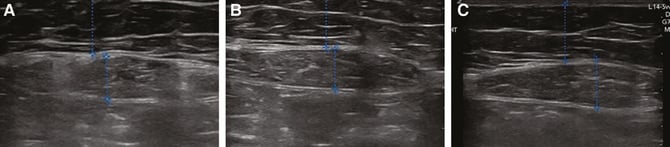
Fig. 1. Longitudinal ultrasound assessment of the anterior abdominal wall during multimodal body contouring (RF–EMS). Standardized high-resolution B-mode scans (identical probe position and depth) depict the rectus abdominis (RA ) and overlying subcutaneous adipose tissue (SAT ) across treatment timepoints, allowing visualization of changes in RA thickness and SAT thickness consistent with muscle hypertrophy and adipose reduction. High-resolution ultrasound scans obtained with the Zone SmartCart Diagnostic System display rectus abdominis and subcutaneous fat at baseline (A, female patient aged 40 y; April 15, 2024), immediately after the fourth RF-EMS session
(B, June 15, 2024), and at 1-month follow-up (C, July 15, 2024), using identical probe position and depth. Across the series, rectus thickness increases and fat layer thins, illustrating progressive myofascial hypertrophy and lipolysis.
Table 2. Key Anthropometric and Ultrasonographic Outcomes (Mean ± SD)
Unit note: The original publication reports thickness and circumference values in centimeters; values in this article are presented in inches (1 in = 2.54 cm) by direct conversion for readability in U.S. clinical settings.
|
Parameter |
Pretreatment |
Posttreatment (1 month) |
Absolute change |
95% CI |
% change |
P value |
|
Rectus abdominis thickness (in) |
0.50 ± 0.07 |
0.59 ± 0.09 |
+0.09 |
0.08 to 0.11 |
+18.83% |
<0.001 |
|
Subcutaneous fat thickness (in) |
0.91 ± 0.19 |
0.67 ± 0.15 |
-0.24 |
-0.27 to -0.21 |
-26.27% |
<0.001 |
|
Waist circumference (in) |
28.59 ± 2.69 |
27.75 ± 2.59 |
-0.84 |
-0.94 to -0.74 |
-2.94% |
<0.001 |
|
Body weight (kg) |
68.73 ± 9.28 |
67.15 ± 8.96 |
-1.58 |
-1.99 to -1.17 |
-2.30% |
0.002 |
|
BMI (kg/m^2) |
24.84 ± 1.62 |
24.24 ± 1.54 |
-0.60 |
-0.75 to -0.45 |
-2.41% |
0.003 |
How to interpret these findings
The combination of a 26% mean reduction in subcutaneous fat thickness and a 19% mean increase in rectus thickness is notable because it suggests concurrent change across layers rather than a single-target effect. Waist circumference decreased by approximately 0.83 in, reinforcing that the ultrasound changes were reflected in an anthropometric measure. Weight and BMI decreased modestly; because diet and activity were not tightly controlled, those reductions should be treated as supportive, not definitive, evidence of treatment-specific metabolic change.
Table 3. Patient-Reported Satisfaction
|
Satisfaction level |
After final treatment |
1 month after treatment |
|
Slightly improved (<25%) |
0 (0%) |
0 (0%) |
|
Moderate improvement (25-50%) |
2 (10%) |
1 (5.5%) |
|
Good improvement (51-75%) |
14 (70%) |
10 (50%) |
|
Very good improvement (>75%) |
4 (20%) |
9 (44.5%) |
Safety and downtime
The authors reported no adverse events or complications during the treatment series or follow-up. Participants resumed daily activities immediately after sessions (no downtime reported).
Mechanistic Rationale (Biologic Plausibility)
The study was not designed to isolate mechanisms, but the authors present a rationale consistent with a multilayer treatment model.
Bipolar RF provides temperature-controlled heating intended to target subcutaneous tissues while cooling and sensors protect the epidermis; mid-40 C tissue temperatures are commonly discussed in relation to adipocyte stress and remodeling pathways. EMS provides repeated high-intensity contractions that may support strength and hypertrophy adaptation over a series. Vacuum suction may mechanically lift tissue (potentially affecting energy deposition depth) while supporting local circulation and lymphatic movement, which could influence perceived firmness and clearance of byproducts.
What this means for MNML Tone
From a MNML Tone clinical education standpoint, the most valuable contribution of this study is objective measurement: ultrasound documents changes in fat and muscle thickness rather than relying on photography alone. That matters because MNML Tone sessions are designed to create a physiologic environment where muscle contraction and tissue response can occur concurrently, with vacuum-enabled tissue lift and fluid dynamics as part of the strategy.
Provider translation (talking points)
Use language that is accurate and patient-friendly:
1) "This approach targets multiple layers at once—fat thickness and muscle thickness—measured by ultrasound in published research."
2) "Results in the study were reported after a series (16 sessions), with measurements taken one month after completion."
3) "This is not a weight-loss treatment; it is a localized contour and muscle-definition support protocol."
Limitations and Evidence Level
This is pilot-level evidence. Limitations include small sample size (N=20), absence of a control group, nonrandomized design, short follow-up (1 month), and limited generalizability beyond the studied population and treatment area. Lifestyle factors were not strictly controlled, which may partially explain weight and BMI changes.
Bottom line for the MNML Tone evidence library
This peer-reviewed pilot study provides ultrasound-verified evidence that a structured series combining bipolar RF, EMS, and vacuum suction can be associated with meaningful reductions in abdominal subcutaneous fat thickness and increases in rectus abdominis thickness, alongside improved waist circumference and high satisfaction with no reported adverse events. In MNML Tone education, these results should be positioned as external support for multilayer protocol plausibility, while clearly stating that the publication did not test the MNML Tone system and that larger controlled studies are required to confirm causality and durability.